Hillsboro Mile's Same Summer: A Record Sale, a Foreclosure, and the Line Between Them
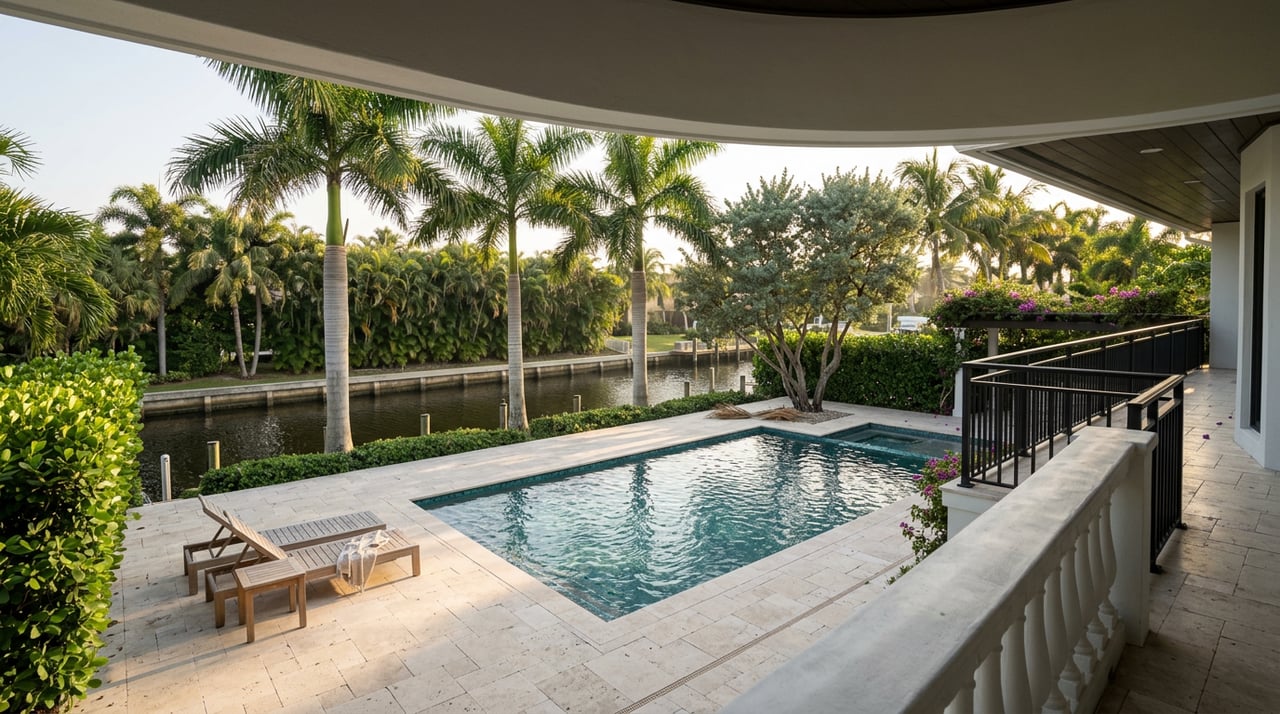
In late July 2026, a trust linked to tech and media executive Mason Paul Slaine closed on a $40.9 million oceanfront estate at 1105-1107 Hillsboro Mile, a sale that came within a few million dollars of the all-time record for a Hillsboro Beach home. About two weeks earlier, a lender called Emerald Creek Capital took control of a different property elsewhere on the same road, through a $40,100 credit bid at a foreclosure auction.
Same three-mile strip. Same summer. Two outcomes that could not look more different. If you're weighing whether to buy on Hillsboro Mile, or whether the address itself is a safe place to put capital, the gap between those two deals is the actual story. Price alone doesn't explain it. What separates a record-setting close from a foreclosure sale isn't the zip code. It's what kind of money was standing behind each property before anyone knew how the year would go.
Hillsboro Mile runs about 3.2 miles through the Town of Hillsboro Beach, a barrier-island municipality with roughly 1,993 year-round residents, a single road, no street lights (a turtle-nesting protection measure), and no commercial zoning at all. Everything you eat, shop for, or fuel up on happens in Deerfield Beach, Pompano Beach, or Boca Raton next door. It is, by design, a place with almost nothing happening except residences.
Which makes it a strange place to run into three genuinely different financial stories inside the same calendar year. Here's the short version of each, side by side:
| Property | What it is | How it was financed | Outcome |
|---|---|---|---|
| 1105-1107 Hillsboro Mile | Single-family trophy estate, 10,100 sq ft, built 2021 | Purchased through a trust, no reported financing | Sold for $40.9M, near-record price |
| 1159 Hillsboro Mile (Hillsboro Beach Resort) | 81-room boutique hotel, built 2021, formerly operated by Sonder | $26M loan from an Emerald Creek Capital affiliate | Defaulted, foreclosed, sold at auction for a $40,100 credit bid |
| 1174-1185 Hillsboro Mile (Rosewood Residences) | 92-unit branded condo tower, 12-acre site | $307M construction loan from Apollo Global Management affiliates | Topped out February 2026, over half presold, on track for early 2027 delivery |
Three properties, three lenders (or none), three outcomes. If you only read the address, you'd assume they were all subject to the same market forces. They weren't.
The Slaine purchase wasn't an outlier in its structure, only in its size. A trust bought the home from another trust, whose sole beneficiary was former Meridian Health Plan CEO David Cotton. Chad Carroll represented the seller, Senada Adzem represented the buyer, and the deal worked out to roughly $4,059 per square foot for the house alone. Earlier in the year, a trust linked to Morris Flancbaum, president of New Jersey-based homebuilder Colts Neck Associates, paid over $36 million for an ocean-to-Intracoastal mansion a few doors down from another home he already owned. Same pattern: a trust, no visible debt, a buyer already established enough to write the check outright.
This is the part of Hillsboro Mile that behaves almost nothing like the rest of the housing market. When a buyer pays cash through a trust, there is no loan-to-value ratio to worry about, no refinancing wall coming due, no lender that can call a note if occupancy or interest rates move against the deal. The 2018 sale of the Playa Vista Isle estate at 935 Hillsboro Mile, which closed for $42.5 million after four years on the market (once listed as high as $159 million) and remains close to the town's all-time record, tells the same story from a different decade. At the very top of this market, the transaction risk isn't financial. It's patience and pricing discipline. That's a fundamentally different risk profile than most real estate carries, and it's the reason record sales here don't move in step with mortgage rates the way they do almost everywhere else.
The Hillsboro Beach Resort at 1159 Hillsboro Mile tells the opposite story. Built in 2021 by entities affiliated with BH3 Management principals Daniel Lebensohn and Gregory Freedman, the 81-room, six-story property was once operated by Sonder, the short-term rental startup that filed for Chapter 7 liquidation after years of financial strain. The ownership entities borrowed $26 million from an Emerald Creek Capital affiliate. When they defaulted, a Broward County judge entered a $40 million final foreclosure judgment in April 2026, and Emerald Creek won the property at a July 16 auction with a $40,100 credit bid.
The mechanics matter more than the drama. A boutique hospitality asset earns its debt service from room revenue, night by night, guest by guest. There's no buyer deposit sitting in escrow to absorb a bad quarter. When the operator behind the rooms collapsed and the debt-to-revenue math stopped working, there was no cushion left between the loan and the lender's own downside. It wasn't the address that failed. It was a highly leveraged, operationally thin structure that had no equity buffer built for a bad year, on a road where almost everything else is owned outright.
Rosewood Residences Hillsboro Beach sits on the 12-acre site at 1174-1185 Hillsboro Mile, developed by Related Group and Dezer Development with architecture by Arquitectonica and interiors by Studio Piet Boon. The project carries a $307 million construction loan from Apollo Global Management affiliates, which sounds like the same kind of leverage that sank the resort next door. It isn't, and the difference is the presale requirement.
Before Related and Dezer drew down that loan at scale, they had already locked in contracts on more than half of the 92 units, at entry pricing that started around $4 million. Vertical construction topped out in February 2026, and the general contractor, Coastal Construction, has the project on track for delivery in early 2027. Remaining inventory now starts at $5.95 million, a sign of how much the sellout has tightened since those early contracts were signed. That presale threshold is what makes $307 million in debt survivable in a way $26 million wasn't for the resort. Buyer deposits sit ahead of the lender's risk. If the market softened tomorrow, Apollo's position is backed by contracts already signed, not by hoping future guests show up.
That's the mechanism worth carrying into any conversation about buying here: leverage isn't automatically dangerous. It's dangerous when it's sized against future performance that hasn't been locked in yet.
If you're comparing Hillsboro Mile to Bay Colony, Sea Ranch Lakes, or another North Broward waterfront enclave, the headline price per square foot tells you almost nothing about how resilient your neighbor's ownership structure is. Before you get serious about a parcel or a resale here, it's worth asking a few questions that the listing sheet won't answer:
Is the seller an individual, a trust, or an entity tied to a construction lender. A trust sale usually means no debt pressure forcing the timeline. An entity name tied to a development loan means there's a repayment clock somewhere behind the deal.
For any new construction nearby, what share of the building was under contract before the loan was drawn. Presale absorption above 50% before vertical construction, the way Rosewood structured it, is a meaningfully different risk than a project breaking ground on spec.
For any hospitality or short-term rental product on the street, who operates it and what happens to debt service if occupancy drops. The resort's failure wasn't really about Hillsboro Beach. It was about a single operator's collapse taking the loan down with it.
None of this changes the physical facts that make the Mile scarce: one road, an ocean on one side and the Intracoastal on the other, and a town that has kept commercial development off its own three miles by design. Scarcity supports the trophy trade regardless of what happens next door. But scarcity doesn't insulate every asset type equally, and 2026 gave the Mile a real-time demonstration of exactly where that insulation ends.
Does one record sale mean the whole corridor is insulated from a downturn? No. The record sale reflects an all-cash buyer at the top of the market. Debt-financed product on the same street, particularly hospitality assets without presale cushions, carries a different risk profile entirely.
Is a $307 million construction loan a red flag for a buyer considering a unit at Rosewood? Not on its own. What matters is that the loan was drawn against a project that had already locked in contracts on more than half its units before vertical construction finished, which is the opposite of the exposure the resort carried.
What happens to a property after a foreclosure sale like the one at 1159 Hillsboro Mile? Ownership passes to the lender, in this case Emerald Creek Capital, which now controls next steps for the site. For a prospective buyer elsewhere on the Mile, the practical takeaway isn't about that specific address. It's a reminder to ask what's financing the property next door before assuming its stability mirrors your own.
Hillsboro Mile isn't one market wearing one price tag. It's three different bets happening to share a road. If you're circling this corridor as a buyer, an investor, or someone weighing a listing against what the summer's headlines suggested, Tagliamonte & Associates can walk through what's actually financing the property next to the one you're considering, and what that means for your own position. Request a Confidential Home Valuation to start that conversation.
Stay up to date on the latest real estate trends.


A top South Florida producer since 2000 and recognized as in the top ½% of real estate producers nationally, Sandra Tagliamonte and Tagliamonte and Associates take pride in their ability to assist clients in the most effective and successful ways.